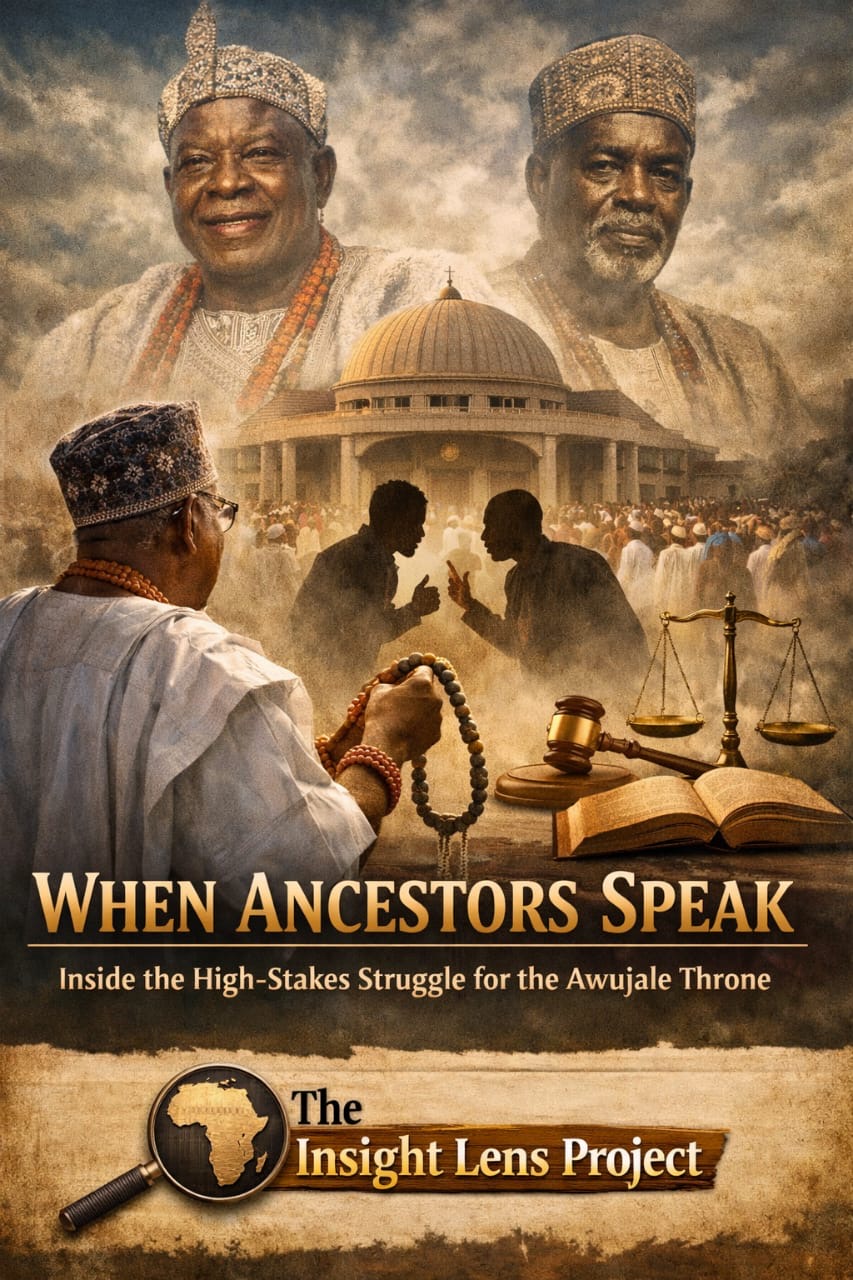
When Ancestors Speak – Inside the High-Stakes Struggle for the Awujale Throne
In Yoruba belief system, death does not disconnect leadership from responsibility. An Oba who journeys to the land beyond is believed to remain spiritually present, guiding his people through memory, tradition, and ancestral authority. As an African proverb reminds us, “If we stand tall, it is because we stand on the shoulders of many ancestors.”
It is within this ancestral order that the ongoing struggle over the succession to the Awujale of Ijebuland must be understood, not merely as a political or legal contest, but as a deeply spiritual reckoning.
Shortly before his transition, the late Awujale, Oba Sikiru Kayode Adetona, used the revered platform of Ojude Oba to issue what many now regard as a solemn charge from the ancestors themselves. His words were unmistakable, the next Awujale must not emerge through monetary inducements, and no “moneybag” should succeed him.
To discerning minds, this was no ordinary admonition. It was the voice of ancestral wisdom channeled through a living custodian of tradition. In that moment, Oba Adetona stood not merely as king, but as a living Opele, articulating the demands of Ijebu ancestors on the character, process, and integrity required for the next occupant of the throne.
To disregard those words, many argue, is to disregard the ancestors themselves, an act believed to invite chaos rather than blessing.
The selection of a new Awujale has already been halted twice by the Ogun State Government, following complaints that due process under the Obas and Chiefs Law of Ogun State and the Ijebu-Ode Chieftaincy Declaration of 1959 was not properly followed.
Petitions reportedly warned that persisting with a flawed process, driven by the Interregnum Committee, certain Olori Ebi, and Afobaje could result in a coronation later overturned by the courts. Such an outcome, critics insist, would stain not only the legacy of the Awujale stool but also the credibility of every stakeholder involved, including the government itself.
Among many in Ijebuland, the prevailing wisdom is simple, it is better to wait and get it right than to rush and plunge the land into decades of spiritual and social uncertainty.
The enthronement of an Awujale is not a routine appointment, it is a delicate passage between the spiritual and the physical realms. Yoruba tradition treats such moments as a binary spectrum where strict adherence to purpose, truth, and ancestral law determines whether peace and prosperity or turmoil and decline will follow.
Youthfulness, elders caution, does not guarantee longevity on the throne. A long, peaceful, and prosperous reign begins with a transparent selection process and the proven character of the Oba. Abandon due process, they warn, and you imperil not only the throne but the life and reign of its occupant.
While no definitive conclusion has been reached, rumours of inducements in the selection process strong enough to warrant the invitation of some kingmakers by the Nigeria Police have already cast a shadow. For a people historically known for industry, discipline, and prosperity, such insinuations are deeply unsettling.
Traditional voices are urging any stakeholder who may have compromised the process to quietly step aside while investigations continue. In ancestral belief, the Aláles (ancestors) are relentless in exposing and dealing with Odáles, betrayers of sacred trust.
Further complicating matters is a troubling procedural anomaly, tradition requires one Apebi and one Jagirin for the installation of an Awujale. Today, two of each reportedly exist.
The implications are profound. Which is legitimate? What spiritual consequences might follow if the wrong officials perform the rites? And how would the courts respond if such foundational irregularities are challenged legally?
These unanswered questions strike at the very heart of legitimacy.
Equally contentious is the role of the Interregnum Committee. Despite an affidavit before a court stating it has no kingmaking function, critics allege the committee remains deeply involved in the process. This contradiction has fueled calls for the government to either clearly define its role or dissolve it altogether and allow the Ilamurens, the traditional kingmakers to perform their duties without interference.
Across Ijebuland, a growing belief persists that the spirit of Oba Adetona remains watchful, frustrating attempts to subvert ancestral dictates. Many see the repeated halts and controversies not as coincidence, but as spiritual resistance.
The hope among the people is unwavering, that the next Awujale will be a true son of the soil, a man of the people, steeped in Ijebu culture, actively rooted in its traditions, and worthy of guarding the ancestral throne. Those long detached from Ijebu land, unfamiliar with its customs and communal life, are widely believed to stand little chance before vigilant ancestors.
As the process pauses once more, one message echoes with growing insistence, the ancestors are awake. And in Ijebuland, their voice still matters.
©️ Adebamiwa Olugbenga Michael is a Lagos-based political economy and policy intelligence analyst and publisher of The Insight Lens Project, providing data-driven insights across Nigeria and West Africa using open-source data.